The Complete Digital Marketing Playbook for 2027: How to Combine SEO, PPC, Social, and AI for Real Growth

Here's a confession to kick things off: there is no single marketing channel that will save your business. We know, we know — that's not what the person selling you a "revolutionary AI ad system" or a "guaranteed #1 ranking" wants you to hear. But it's the truth, and since we're friends here, we'd rather tell you the truth than sell you a silver bullet. (Silver bullets are for werewolves anyway, and we're more of a wolf-pack operation.)
As we look ahead to 2027, the businesses that win online won't be the ones chasing whatever channel is trendy this quarter. They'll be the ones who understand how all the pieces fit together — search, ads, social, email, web design, and the fast-emerging world of AI-driven discovery — working as one coordinated system. Think of it less like picking a favorite child and more like conducting an orchestra. Every instrument matters, and the magic happens when they play together.
So let's walk through the whole playbook: what each channel actually does, when to lean on it, and — the part almost nobody explains clearly — how to make them work together for 360-degree, short-and-long-term growth.
Why 2027 Is Different: AI Changed the Map
For twenty years, digital marketing had a fairly stable center of gravity: rank on Google, run some ads, maybe post on social. That map is being redrawn in real time. People increasingly ask AI assistants for recommendations instead of scrolling through ten blue links. Google's own results now lead with AI-generated overviews that answer questions before a user ever clicks. Search, shopping, and discovery are becoming conversations rather than lists.
What does that mean for you? It means visibility is no longer just about "ranking" — it's about being the business that AI systems understand, trust, and recommend. It means your website has to be readable by both humans and machines. And it means the old habit of treating each channel as a separate silo is officially past its expiration date. In 2027, the channels don't just coexist — they feed each other. Let's meet the players.
One more thing before we dive in. There's a temptation, every time technology shifts, to panic and assume everything you knew is now worthless. Resist it. AI hasn't thrown out the fundamentals of good marketing — it's raised the stakes on them. Clear communication, genuine helpfulness, real trust, and a great customer experience mattered in 2010, they matter now, and they'll matter in 2027. The tools change; the human on the other end of the screen does not. Keep that person at the center of everything, and you'll adapt to whatever comes next without breaking a sweat.
The Foundation: SEO (Your Long Game That Keeps Paying)
Search engine optimization is the compound interest of digital marketing. It's slow to start, occasionally frustrating, and then one day you realize it's quietly become your most valuable asset. Unlike ads, which stop the second your budget runs dry, a strong organic ranking keeps delivering traffic month after month without a per-click cost.
Great SEO in 2027 is built on the same fundamentals it always was — genuinely useful content, a technically sound website, and real authority — but the bar for "genuinely useful" keeps rising. Google's newer guidelines reward first-hand experience, clear expertise, and content that actually answers the question rather than dancing around it for 1,500 words. (We promise this post is dancing with purpose.)
When to lean on it: Always, but especially when you're playing the long game and want traffic that compounds. If you want to own your space rather than rent it, SEO is your foundation.
The New Frontier: AI SEO (Getting Recommended by the Machines)
Here's the channel that didn't really exist a few years ago and is now impossible to ignore. When someone asks an AI assistant "who's the best digital marketing studio near Vaughan?" or "what should I look for in a PPC agency?", something decides which businesses get mentioned. AI SEO is the practice of making sure that something is talking about you — accurately and favorably.
It overlaps with traditional SEO but isn't identical. AI systems care about structured data, clear and consistent information about your business across the web, content that directly answers real questions, and signals of trust and authority that a language model can parse. Traditional SEO gets you on the results page; AI SEO gets you into the answer itself.
When to lean on it: Right now, honestly. Being early here is a genuine advantage, because most of your competitors are still pretending AI search is a phase. (It is not a phase, Mom.)
The Neighborhood Hero: Local SEO (Winning Your Own Backyard)
If you serve a specific geographic area — a city, a region, the Greater Toronto Area — Local SEO is where a lot of your highest-intent customers live. When someone searches "emergency plumber near me" or "best coffee shop open now," they're not browsing. They're ready to act. Local SEO makes sure you're the one they find.
This means a fully optimized Google Business Profile, consistent business information everywhere it appears, genuine reviews, and location-relevant content. It's one of the highest-ROI activities for any business with a physical presence or a defined service area, and it pairs beautifully with both traditional and AI-driven search.
When to lean on it: If your customers are geographically defined. A dentist in Vaughan doesn't need to rank in Vancouver — they need to own their neighborhood.
The Fast Lane: PPC & Paid Ads (Instant Visibility, On Demand)
SEO is the marathon; PPC is the sprint. Paid ads are the fastest way to appear at the very top of search results and in front of precisely the audience you want — today, not in six months. You control the budget, the targeting, and the timing, and you can measure nearly every dollar.
The trade-off, of course, is that the traffic stops the moment you stop paying. Ads are a faucet, not a well. That's not a flaw — it's just their nature, and it's exactly why paid ads work best when they're part of a bigger system rather than your entire strategy. Use them to capture demand now while your organic foundation builds underneath.
When to lean on it: Product launches, promotions, seasonal pushes, testing new markets, or any time you need results faster than organic can deliver. Also perfect for capturing high-intent searches while you earn those rankings organically.
The Relationship Builder: Social Media Marketing (Where Trust Grows)
Social media rarely gets the last click, so it's chronically underrated by people obsessed with last-click attribution. But it's often where the relationship begins. It's where people discover your brand's personality, see proof that real humans stand behind it, and slowly decide whether they trust you. Trust, it turns out, is hard to buy and easy to lose.
Social media marketing in 2027 is less about posting into the void every day and more about being genuinely present, consistent, and human where your audience already spends time. You don't need to be on every platform — you need to be strategically good on the one or two that matter for your business.
When to lean on it: Building brand awareness, humanizing your business, nurturing an audience over time, and supporting product launches with buzz. It's the warm-up act that makes every other channel convert better.
The Home Base: Web Design (Where Everything Converts — or Doesn't)
Here's an uncomfortable truth: you can win at every other channel and still lose if your website is a mess. Every SEO ranking, every ad click, every social visitor, every email link — they all funnel to your site. If that site is slow, confusing, or doesn't work on a phone, you're pouring water into a leaky bucket. And nobody likes a leaky bucket.
Great web design isn't about being the prettiest site on the block (though looking sharp doesn't hurt). It's about loading fast, guiding visitors clearly toward a single obvious action, building trust in seconds, and working flawlessly on the device most of your traffic actually uses — the phone. Your website is the one asset you fully own and control, which makes it the most important conversion tool in your entire arsenal.
When to lean on it: Before you scale spending on any other channel. Fixing conversion on your site multiplies the return on everything else you do. It's the least glamorous investment with the highest quiet payoff.
The Quiet Powerhouse: Email Marketing (Your Highest-ROI Channel)
Email consistently delivers the best return on investment of any digital channel — often $36 to $40 for every $1 spent — and yet most businesses barely tap it. Why? Because it's not shiny. It doesn't have a trendy algorithm. It just... works, reliably, year after year, like the dependable friend who always shows up.
The magic of email marketing is ownership. You don't rent your email list from a platform that can change the rules tomorrow — you own that direct line to people who already raised their hand and said "tell me more." With smart automation — welcome sequences, cart reminders, re-engagement flows — email turns one-time visitors into repeat customers while you sleep.
When to lean on it: Always, and especially for nurturing leads and driving repeat business. Every other channel should be feeding your email list, because that's where you convert interest into loyalty.
A Quick Reality Check on Budgets
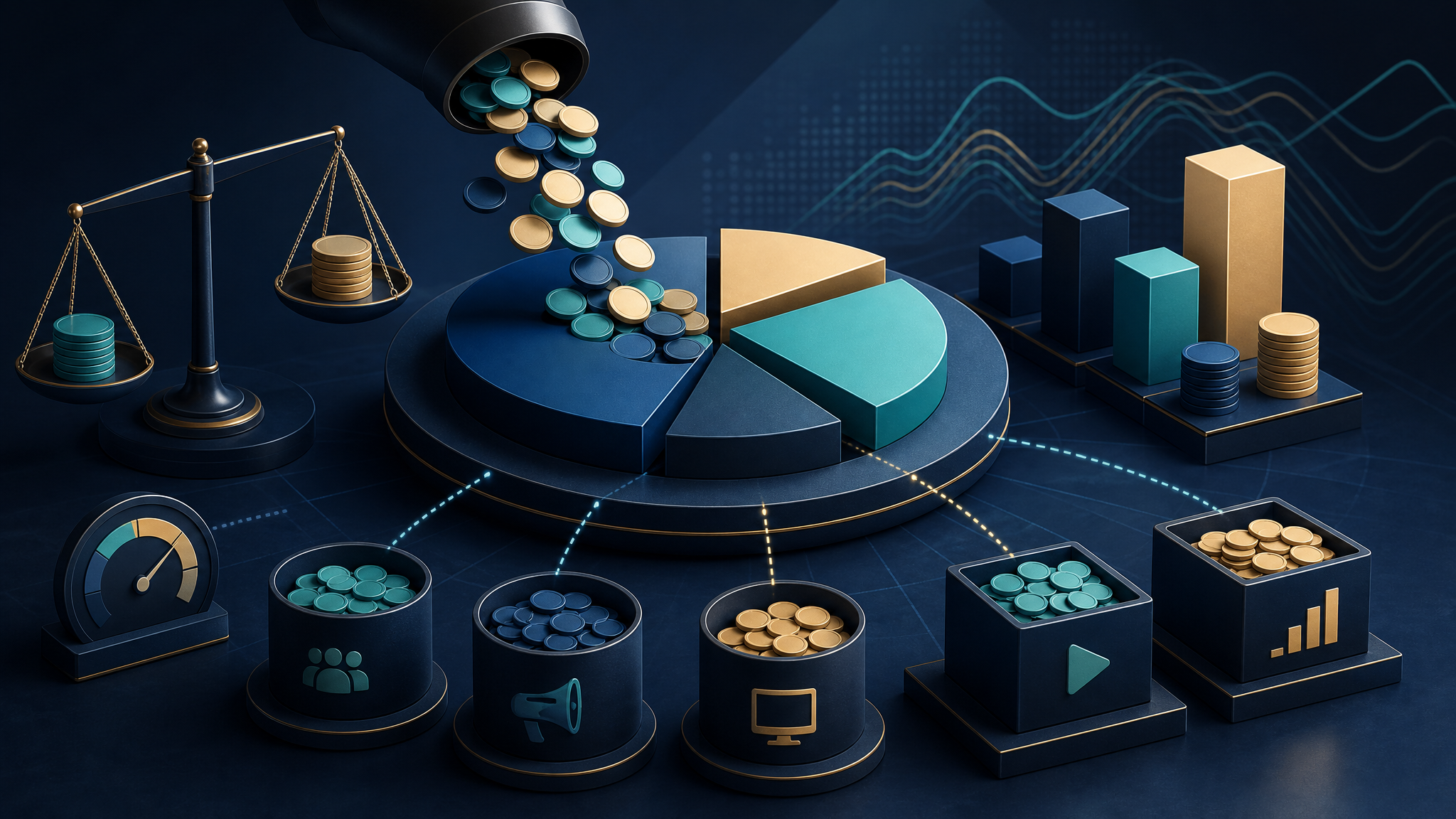
One question we hear constantly: "How do I split my budget across all of this?" There's no universal answer, but there is a sane starting point. A useful rule of thumb is the 70-20-10 split — put roughly 70% of your budget into the channels already proven to work for you, 20% into channels with strong potential that you're actively scaling, and 10% into genuine experiments. This keeps you stable without going stale.
Notice what that framework quietly assumes: that you're running more than one channel at once. A business pouring 100% into a single channel isn't focused — it's exposed. Algorithms shift, ad costs rise, platforms change their rules overnight. Diversification isn't just good marketing; it's risk management. If one channel has a bad month, the others keep the lights on. Wolves hunt in packs for a reason.
And here's a gentle myth to bust: a bigger budget is not automatically a better one. We've watched businesses with modest budgets outperform far bigger spenders simply because their channels were coordinated instead of competing. Strategy beats spend, every single time. The goal isn't to spend the most — it's to make every dollar do double duty by working across the system.
The Real Secret: They Work Best Together
Now for the part the silo-sellers skip. Each channel above is useful on its own. But the compounding, business-transforming results happen when they operate as a single coordinated system. Let us show you what that actually looks like in practice, because "synergy" is a word that means nothing until you see it move.
Picture a customer's real journey. They ask an AI assistant for a recommendation, and thanks to your AI SEO, your name comes up. Curious, they search you on Google, where your SEO and Local SEO mean you dominate the results. They click a PPC ad you're running to capture that exact high-intent moment. They land on a fast, clear, trustworthy site built by smart web design, and they're impressed. Not quite ready to buy, they follow you on social, where your social media presence reassures them you're the real deal over the next couple of weeks. They join your list, and your email marketing nurtures them until the day they're ready — and they convert. Then email keeps them coming back.
No single channel did that. The system did that. Each one handed off to the next, covering a different stage of the journey and a different psychological need. That's what we mean by 360-degree, holistic marketing: short-term channels (PPC, social) creating momentum while long-term channels (SEO, AI SEO, email) build durable assets, all pointing at a website engineered to convert.
How to Actually Build Your Mix (The Practical Part)
Theory is nice, but you have a business to run. Here's a practical way to think about assembling your own holistic mix without lighting your budget on fire.
Start with the foundation. Before spending heavily to drive traffic, make sure your website converts. A leaky bucket wastes every dollar you pour in. Fix conversion first — it's the multiplier for everything else.
Balance short-term and long-term. A healthy mix pairs at least one fast channel (PPC or paid social) with at least one compounding channel (SEO, AI SEO, or email). The fast channel pays the bills while the slow one builds the moat. Neglect the long game and you'll be renting attention forever; neglect the short game and you'll starve before the compounding kicks in.
Always be capturing emails. Whatever brings someone to your site, give them a reason to join your list. Email is where you turn borrowed attention into owned relationships — the single best insurance policy against any one platform changing its rules.
Match channel to goal, not to hype. Need leads this week? Paid. Building an asset for next year? Organic. Launching something? Social plus paid plus email, in concert. Don't pick channels because they're trendy — pick them because they fit the job in front of you.
Measure holistically. Resist the urge to judge each channel purely on last-click credit. That social post that "didn't convert" may have been the reason the email converted three weeks later. Look at overall growth and cost of acquisition across the whole system, not one instrument in isolation.
The Anti-Gatekeeping Promise
Here's the thing that gets us out of bed in the morning. None of this is secret knowledge reserved for businesses with five-figure monthly retainers. The strategy above isn't magic — it's just coordination, executed with a little patience and a lot of honesty. The reason it feels overwhelming is that most of the industry profits from making it seem more complicated than it is.
We started The Urban Wolf Studio because we've worked inside agencies, we've seen how the sausage is made, and we believe growing businesses deserve big-agency quality without the big-agency mystique or the big-agency invoice. You shouldn't need to hire six different specialists and a translator to understand your own marketing. You should have a partner who explains it plainly, builds the system with you, and actually cares whether it works.
The future of digital marketing in 2027 isn't about chasing the next shiny channel. It's about building a connected, resilient system where SEO, AI SEO, local search, paid ads, social, web design, and email all pull in the same direction. Get that right, and you're not just keeping up — you're compounding, quarter after quarter.
Ready to build a marketing system that actually works together? Explore what we do, and let's make your channels play like an orchestra instead of a one-person band with a very tired kazoo. We're friends here — and friends don't let friends market alone.
Related Articles
Ready to Simplify Your Marketing?
No more overpaying for marketing that underdelivers. Get a free consultation and see how we can help you grow.
Get in Touch