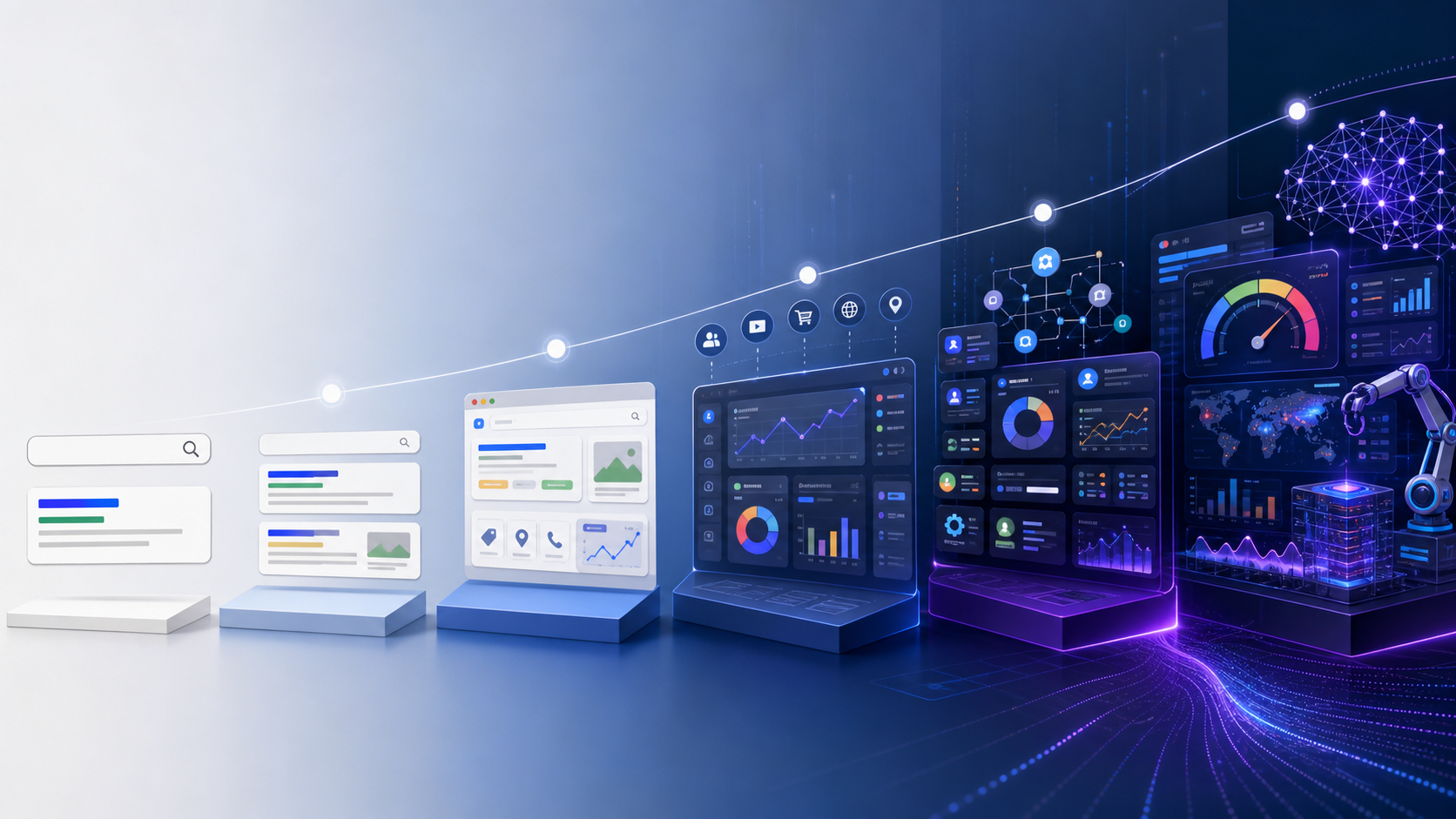
Type a few words into Google today and, in the blink of an eye, an invisible auction plays out. Thousands of advertisers, algorithms, and machine-learning models compete for a sliver of your attention. It happens billions of times a day, and it is the engine behind one of the most profitable businesses in human history. But it did not start that way. It started with a simple idea, a self-serve signup form, and a $350 million bet that would quietly reshape the entire internet.
This is the story of how Google Ads went from a scrappy little product called AdWords to a sprawling, machine-driven advertising empire — and why, somewhere along the way, running a few ads became complicated enough to justify an entire multibillion-dollar management industry. More importantly, it is the story of why we think that complexity has been oversold, and how we are working to make pay-per-click advertising accessible to the businesses that actually need it.
In the Beginning: The Birth of AdWords (2000)
In October 2000, Google launched AdWords with a grand total of 350 advertisers. To put that in perspective, Google itself was barely two years old, still better known as "that clean search engine" than as an advertising juggernaut. The founders, Larry Page and Sergey Brin, had famously been skeptical of advertising at all. Their 1998 academic paper on search even warned that ad-funded search engines would be "inherently biased towards the advertisers and away from the needs of consumers."
So when AdWords arrived, it was designed to be different. The original product was refreshingly simple. You wrote a short text ad. You chose some keywords. You set a monthly budget. Ads were priced on a cost-per-thousand-impressions (CPM) basis at first, and the whole thing was self-serve — no salesperson, no minimum spend of tens of thousands of dollars, no gatekeeping. A small business owner could sit down at their computer and have an ad running the same afternoon. That accessibility was the entire point.
The genius of early AdWords was not the technology — it was the democratization. For the first time, a local florist could compete for attention on the same page as a national chain, and pay only when the strategy worked. It felt fair. It felt simple. And it worked.
The Idea That Changed Everything: Pay-Per-Click and Quality Score (2002)
The real revolution came in February 2002, when Google overhauled AdWords around a pay-per-click (PPC) model — you only paid when someone actually clicked your ad. But Google added a twist that competitors like Overture (formerly GoTo.com) had missed: your ad's position was not determined by bid alone. It was determined by bid multiplied by relevance.
This was the birth of what would eventually be called Quality Score. Google reasoned that an ad people actually wanted to click was more valuable — to users and to Google — than an ad from someone who simply outspent everyone else. A well-targeted ad with a high click-through rate could outrank a competitor bidding twice as much. It aligned everyone's incentives: better ads won, users saw more relevant results, and Google made more money per search.
It was elegant. It was, for the advertiser, still comprehensible. You could hold the entire mental model of how AdWords worked in your head: write relevant ads, pick good keywords, bid sensibly, and keep your click-through rate healthy. The learning curve existed, but it was a hill, not a mountain.
Scaling Up: The Content Network and Global Expansion (2003–2009)
Google did not stay still. In 2003, it acquired Applied Semantics and launched AdSense, extending ads beyond search results onto millions of third-party websites. AdWords advertisers could now choose to appear not just when someone searched, but while they read a blog, checked the news, or browsed a hobby forum. The "Content Network" (later the Google Display Network) was born, and with it, the first real jump in complexity.
Suddenly advertisers had to think about two very different environments. Search advertising captured active intent — someone typing "emergency plumber near me" is ready to buy. Display advertising interrupted passive browsing and worked on a completely different psychology. The same ad, the same budget, and the same keywords could produce wildly different results depending on where they ran. Managing AdWords started to require genuine strategy.
Through the mid-2000s, Google layered on more: conversion tracking (2005) so you could finally measure what happened after the click, site-targeting, image ads, and increasingly granular controls. Each addition was individually reasonable. Collectively, they were the first snowflakes of what would become an avalanche.
The Mobile Earthquake: Enhanced Campaigns (2013)
Then the smartphone changed everything. By the early 2010s, a rapidly growing share of searches came from phones, and the old desktop-first campaign structure was buckling. In 2013, Google introduced Enhanced Campaigns, a sweeping overhaul that forced advertisers to think about devices, locations, and times of day as bid modifiers layered on top of their existing campaigns.
Enhanced Campaigns were controversial. Many advertisers felt they lost fine-grained control — you could no longer cleanly separate desktop and mobile into different campaigns the way you used to. But the direction of travel was clear: Google was beginning to make more decisions on the advertiser's behalf, bundling complexity behind the scenes while asking advertisers to trust its automation. The mental model of "I control every lever" was starting to crack.
The Rebrand: AdWords Becomes Google Ads (2018)
By 2018, "AdWords" no longer described what the product actually was. Ads now ran across Search, Display, YouTube, Gmail, Maps, the Play Store, and an ever-expanding universe of surfaces. The word "words" felt quaint. So in July 2018, on the product's near-18th birthday, Google retired the AdWords name and rebranded the whole ecosystem as Google Ads.
The rename was cosmetic, but it signaled something deeper. Google was no longer selling keyword-triggered text ads. It was selling access to its entire audience, everywhere, powered increasingly by machine learning. The rebrand marked the moment the platform stopped being a tool you operated and started becoming a system you fed.
The Automation Era: Smart Bidding and the Rise of the Black Box (2018–2021)
This is where the story really turns. Over the following years, Google leaned hard into automation. Smart Bidding strategies — Target CPA, Target ROAS, Maximize Conversions, Maximize Conversion Value — used machine learning to set bids in real time for every single auction, adjusting for hundreds of signals no human could ever process manually: device, location, time, browser, past behavior, audience, and much more.
On paper, this was a gift. Let Google's models do the heavy lifting. In practice, it moved the controls further and further out of the advertiser's hands and into an opaque system. You no longer set bids; you set goals and hoped the algorithm agreed with you. Responsive Search Ads replaced the old hand-crafted text ads, mixing and matching your headlines automatically. Broad match keywords — once a budget-burning trap — were rehabilitated and encouraged, because the machine could supposedly interpret intent better than exact match ever could.
The advertiser's job quietly transformed. It was no longer about pulling levers. It was about feeding the machine the right inputs — clean conversion data, strong creative assets, sensible goals — and then interpreting what came out the other side. The skills required did not shrink. They shifted, and in many ways they became harder to see, harder to teach, and harder to verify.
Performance Max and the Full Black Box (2021–Today)
In late 2021, Google launched Performance Max, and it represents the logical endpoint of two decades of evolution. With a single Performance Max campaign, you hand Google your budget, your goals, your creative assets, and your audience signals — and the machine decides everything else. Which network. Which placement. Which format. Which bid. Which audience. All of it, automatically, across Search, Display, YouTube, Gmail, Maps, and Discover simultaneously.
Performance Max can be genuinely powerful. It can also be a black box that spends your money in ways you cannot fully see or control, with reporting so limited that diagnosing problems becomes an art form. The advertiser who once held the entire system in their head now stares at a dashboard of aggregated results, trying to reverse-engineer what the algorithm actually did.
And this is the crucial point: the platform did not get simpler as it got smarter. It got more opaque. The complexity did not disappear — it moved. It went from being explicit (lots of visible settings you had to configure) to being implicit (a small number of high-stakes decisions whose consequences are hard to predict and harder to audit). That shift is exactly what created the modern PPC management industry.
AdWords 2000 vs. Google Ads Today: A Side-by-Side Reality Check
Nothing captures the transformation better than looking at the two eras side by side. Here is how the original AdWords compares to the platform businesses face in 2026:
| Dimension | AdWords (2000–2005) | Google Ads (2026) |
|---|---|---|
| Ad formats | Simple text ads | Responsive search, display, video, shopping, app, demand-gen, and Performance Max asset groups |
| Bidding | Manual, set-it-yourself CPC | AI-driven Smart Bidding across hundreds of live auction signals |
| Keyword control | Exact, precise, fully in your hands | Broad match encouraged; the algorithm interprets intent |
| Networks | Search results only | Search, Display, YouTube, Gmail, Maps, Discover — often all at once |
| Transparency | You could see exactly what drove results | Aggregated reporting; limited visibility into the black box |
| Learning curve | An afternoon | Weeks to months — plus constant re-learning as features change |
Look at that final row. That is the whole story in miniature. The original AdWords could be learned in an afternoon. Today's Google Ads requires weeks of study just to reach competence — and because Google ships changes constantly, that education never really ends. That gap between "an afternoon" and "never-ending" is the space where the entire PPC management industry lives.
How PPC Management Became a Multibillion-Dollar Industry
Here is a number that should give you pause. Global digital advertising spend now runs well into the hundreds of billions of dollars a year, and Google's own advertising revenue alone has grown from a rounding error in 2001 to over a quarter of a trillion dollars annually. Take a look at the trajectory:
Google / Alphabet Annual Ad Revenue (approx.)
An industry that big does not just attract advertisers — it attracts an entire ecosystem of intermediaries. Agencies, freelancers, consultants, software platforms, certification programs, and "gurus" all sprang up to help businesses navigate a system that had become genuinely difficult to operate. And here is the uncomfortable truth: the harder Google made its platform, the more valuable that middle layer became.
Consider the sheer machinery that grew up around the platform. Google rolled out its own certification programs, minting hundreds of thousands of "certified" professionals. A cottage industry of third-party bid-management and reporting tools emerged, each charging monthly subscriptions to tame features Google itself had introduced. Conferences, courses, newsletters, and consultants multiplied. None of this existed in 2002, because in 2002 you did not need it. The ecosystem is a direct measure of how far the platform drifted from its original simplicity.
Complexity, it turns out, is a business model. When a platform is simple, expertise is cheap and abundant. When a platform is bewildering, expertise becomes scarce and expensive. Every new feature, every automation layer, every reporting change created a fresh reason for a business to throw up its hands and say, "I can't keep up with this — I need to hire someone." The PPC management industry did not grow because ads got more effective. It grew, in large part, because ads got more confusing.
The Complexity Premium: What Businesses Actually Pay
Walk into the average PPC agency and you will find a familiar pricing structure: a management fee, often a percentage of your ad spend or a flat monthly retainer, that frequently starts at $600, $1,000, or even several thousand dollars a month — on top of what you pay Google. For a small business spending $2,000 a month on ads, a management fee can easily represent 25% to 50% of the total budget. You are paying a steep premium not for the ads themselves, but for someone to translate the complexity on your behalf.
To be clear: skilled PPC management has real value. A genuinely good campaign manager can save you far more than they cost by cutting wasted spend, sharpening targeting, and improving conversion rates. The problem is not that expertise costs money. The problem is that the industry has learned to sell the complexity itself as the product — to make the platform sound so impossibly arcane that businesses feel they have no choice but to pay whatever is asked, indefinitely, without ever understanding what they are paying for.
Our Contrarian Take: The Learning Curve Is Steep, But the Work Isn't Rocket Science
Here is what a lot of agencies would rather you not hear. Yes, Google Ads has a steep learning curve. Yes, it takes real time and effort to get past that initial wall of jargon, settings, and shifting best practices. But once you are over that hill? The day-to-day work of running effective, profitable campaigns is far more straightforward than the industry lets on.
The dirty secret of PPC is that a huge portion of great campaign management comes down to a handful of durable fundamentals: understand what a conversion is actually worth to your business, feed the platform clean and accurate conversion data, write ads that speak to real intent, send clicks to landing pages that deliver on the promise, ruthlessly cut what is not working, and double down on what is. That is not nothing — but it is not a dark art either. It is a skill, like any other, that becomes routine with a little guidance and a lot of honesty.
We have watched business owners freeze up in front of the Google Ads dashboard, convinced they were staring at something they could never hope to understand. And then, twenty minutes into a plain-English walkthrough, the exact same person is confidently making sound decisions about budgets and targeting. The barrier was almost never intelligence or aptitude. It was jargon, intimidation, and a lack of anyone willing to explain it without an agenda. Remove those, and the mystique collapses.
The complexity you see in the interface is largely Google's problem to manage, not yours. Once someone shows you which levers actually matter and which are noise, the fog lifts. What is left is a learnable, repeatable process — one that absolutely does not justify locking businesses into open-ended four-figure monthly contracts forever.
Our Mission: Making PPC Accessible Again
This is why The Urban Wolf Studio exists. We started this studio because we have worked inside agencies, we have seen how the sausage is made, and we got tired of watching small businesses get charged big-agency prices for work that, frankly, is not as mysterious as it is made out to be.
We want to take Google Ads back to its roots — back to the spirit of that original 2000 launch, when a small business owner could run a real, competitive ad campaign without needing a translator, a consultant, and a five-figure annual budget. The platform got more complicated. Our promise is to absorb that complexity so you do not have to, and to do it honestly, transparently, and at a price that actually makes sense for a growing business.
That means we will tell you when PPC is the right tool — and when it is not. Because here is another thing the ads industry rarely admits: paid ads are not always the answer. Sometimes the smarter long-term play is to build organic visibility that keeps working long after you stop paying for clicks.
When Ads Aren't the Answer: The Organic Alternative
Every click you buy on Google Ads stops the moment your budget runs out. That is the fundamental trade-off of paid advertising: it is a faucet, not a foundation. Turn it off, and the traffic disappears. For many businesses, the healthiest strategy is to use PPC for immediate, intent-driven results while simultaneously building an organic presence that compounds over time and does not vanish when you stop paying.
That is where search engine optimization comes in. A strong SEO strategy earns you rankings you own rather than rent — visibility that keeps delivering traffic and leads month after month without a per-click cost. It is slower to build than a paid campaign, but far more durable, and over a long enough horizon it is dramatically more cost-effective than pouring money into ads forever.
And the game is changing again. As more people turn to AI assistants and AI-powered search to find answers, being visible in those AI results is becoming just as important as ranking on a traditional results page. Our AI SEO service is built for exactly this shift — positioning your business to be found and recommended by the AI tools your customers increasingly rely on. Think of both SEO and AI SEO as the organic counterweight to paid ads: the assets that keep working when the ad budget is switched off.
The right answer for most businesses is not "ads or organic." It is a deliberate blend — paid for speed and control, organic for durability and compounding returns — sized honestly to your goals and your budget rather than to an agency's revenue targets.
The Bottom Line
Google Ads has come an astonishingly long way from that simple text-ad product launched with 350 advertisers in the autumn of 2000. It has become one of the most sophisticated, powerful, and profitable advertising systems ever built. But sophistication came at the cost of simplicity, and somewhere in that transformation, an entire industry learned to profit from the confusion.
We think there is a better way. The learning curve is real, but the work on the other side of it is honest, learnable, and worth doing well — without the mystique and without the runaway fees. If you are tired of feeling locked out of your own advertising, or you are paying a premium for complexity you were never allowed to understand, let's talk. Take a look at how we approach PPC management — big-agency quality, without the big-agency attitude, and without the big-agency invoice.
Related Articles
Ready to Simplify Your Marketing?
No more overpaying for marketing that underdelivers. Get a free consultation and see how we can help you grow.
Get in Touch